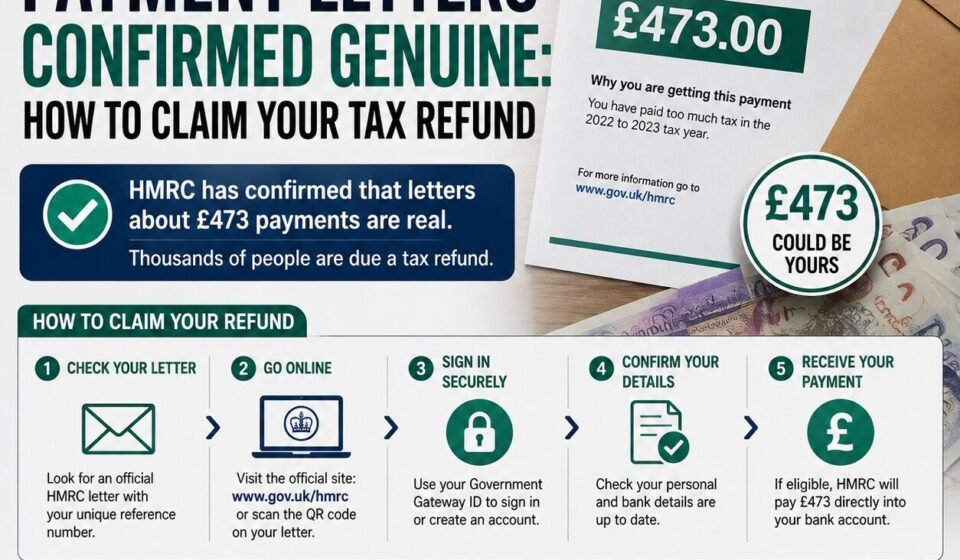
HMRC £473 Payment Letters Confirmed Genuine: How to Claim Your Tax Refund

HM Revenue and Customs (HMRC) has confirmed that thousands of official P800 tax calculation letters arriving in postboxes across the United Kingdom—notifying workers that they are owed an average tax refund of £473—are entirely genuine. The tax authority is urging recipients not to ignore these notices, as hundreds of thousands of taxpayers have yet to collect money held in overpaid income tax.
The notifications are part of HMRC’s annual end-of-year tax reconciliation process for Pay As You Earn (PAYE) workers and pensioners. While millions of P800 calculation letters were dispatched over the summer months, government figures indicate that nearly 700,000 individuals have still not claimed their funds.
“We wrote to customers to inform them they are due a refund, and need to claim it. Customers can follow the straightforward instructions in the letter, which explain how they can quickly and easily claim it online on GOV.UK or via the HMRC app.”— HMRC Official Spokesperson
What Are the HMRC £473 Payment Letters?
The formal document being distributed is known as a P800 Tax Calculation letter. HMRC issues a P800 at the end of each tax year after comparing the total tax collected by employers and pension providers against what an individual was actually obligated to pay.
If the calculation reveals that an individual paid more Income Tax or National Insurance than required, HMRC generates a P800 notice detailing the exact overpayment and outlining the steps required to receive a direct bank payout or cheque.
While £473 represents the average refund amount calculated across recent claims, individual rebates vary significantly. Depending on employment changes and tax code errors over recent years, some taxpayers receive smaller adjustments, while others qualify for payouts running into thousands of pounds.
Why Do So Many Workers Overpay Tax?
Overpaying Income Tax is a common occurrence in the UK PAYE system. Because employers automatically deduct tax based on tax codes issued by HMRC, any sudden shift in an employee’s work pattern or personal circumstances can lead to incorrect withholding rates.
-
Incorrect Tax Codes: The standard Personal Allowance tax code for most UK workers is 1257L, which allows up to £12,570 in tax-free earnings per year. If an employee is accidentally assigned an emergency tax code or an incorrect letter code (such as BR or T), tax may be deducted without applying full personal tax-free allowances.
-
Job Changes Mid-Year: Switching employers mid-tax year often causes temporary payroll discrepancies, especially if the new employer does not receive P45 details in time.
-
Multiple Income Sources: Holding more than one job simultaneously or combining part-time employment with a private pension frequently results in incorrect tax deductions across secondary income streams.
-
Periods of Unemployment: Stopping work partway through the tax year means the worker may not have utilized their full annual Personal Allowance before tax deductions ceased.
-
Taxed Savings & Benefits: Taxable state benefits, company perks (such as company cars or healthcare), or savings interest miscalculated by financial institutions can trigger overpayments.
Common UK Tax Codes & What They Mean
Understanding your tax code helps ensure you are paying the correct amount of tax throughout the year. The table below breaks down the most frequent HMRC tax code letters:
| Tax Code Letter | What It Indicates | Common Impact on Take-Home Pay |
| 1257L | Standard tax-free Personal Allowance (£12,570/year). | Correct tax-free threshold applied for single job. |
| BR / SBR | Basic Rate code (20% flat tax on all earnings). | Applied to second jobs; no tax-free allowance included. |
| M | Marriage Allowance received from a spouse or civil partner. | Increases tax-free allowance by 10%. |
| N | Marriage Allowance transferred to a spouse or civil partner. | Slightly reduces personal tax-free allowance. |
| S | Income taxed under Scottish Income Tax rates. | Applies Scottish tax brackets to earnings. |
| T | Tax code requires further review by HMRC. | Temporary code used while HMRC reviews records. |
Step-by-Step: How to Claim Your £473 Tax Refund
Receiving a genuine P800 letter gives you several simple options to claim your overpaid tax.
-
Verify via the Official HMRC App: Download the official HMRC App from the Apple App Store or Google Play Store. Log in using your Government Gateway user ID and password to view your P800 calculation directly on screen.
-
Claim Online via GOV.UK: Sign in to your Personal Tax Account at
gov.uk/personal-tax-account. Navigate to the “Pay As You Earn (PAYE)” section to submit your UK bank details (sort code and account number) for a direct electronic transfer. -
Automatic Cheque Payment: If your P800 letter explicitly states that HMRC is sending a payable cheque, you do not need to take online action. The physical cheque will be posted directly to your registered address within 14 days of the letter date.
-
Phone or Postal Claims: If you cannot access digital services, contact HMRC directly by telephone at 0300 200 3300 or write to: Pay As You Earn and Self Assessment, HM Revenue and Customs, BX9 1AS.
Tax Refund Claim Deadlines: How Far Back Can You Claim?
UK tax legislation allows taxpayers to claim refunds for overpaid Income Tax for up to four tax years after the end of the tax year in which the overpayment occurred.
┌─────────────────────────────────────────────────────────┐
│           HMRC TAX REFUND BACKDATE TIMELINE             │
├──────────────────────────┬──────────────────────────────┤
│ Tax Year Overpaid        │ Final Deadline to Claim      │
├──────────────────────────┼──────────────────────────────┤
│ 2021 / 2022 Tax Year     │ 5 April 2026                 │
│ 2022 / 2023 Tax Year     │ 5 April 2027                 │
│ 2023 / 2024 Tax Year     │ 5 April 2028                 │
│ 2024 / 2025 Tax Year     │ 5 April 2029                 │
└──────────────────────────┴──────────────────────────────┘
Missing a claim deadline permanently forfeits your right to recover overpaid tax for that specific tax year.
How to Spot Fake HMRC Letters & Avoid Scams
Because public news regarding the £473 refund letters has spread widely, fraudsters and phishing syndicates are actively attempting to impersonate HMRC using fake letters, text messages, and emails.
Tax experts and consumer protection organizations urge taxpayers to double-check all incoming communications against known security red flags:
-
No Text or Email Refund Alerts: HMRC never sends unsolicited emails, SMS text messages, or WhatsApp notifications containing direct links to claim a tax refund. Genuine initial notices arrive exclusively by post.
-
Check the Unique Taxpayer Reference: Legitimate HMRC letters always display your official Tax Reference Number or National Insurance Number. Fake letters often contain vague greetings or generic account references.
-
Demands for Immediate Payment: Authentic P800 notices explain calculations calmly. If a letter demands urgent payment, threatens legal arrest, or pressures you to call an unofficial telephone number, it is a scam.
-
Requests for Bank Details via Unsecure Forms: HMRC will never ask you to fill out paper bank details or hand over credit card numbers via return mail. All digital refunds are processed through secure logins on the official
gov.ukportal or official app.
If you receive a suspicious letter claiming to be from HMRC, verify its authenticity by logging directly into your personal tax account via GOV.UK rather than using contact numbers printed on the letter. Fraudulent attempts should be reported immediately to Action Fraud or HMRC’s dedicated phishing team.