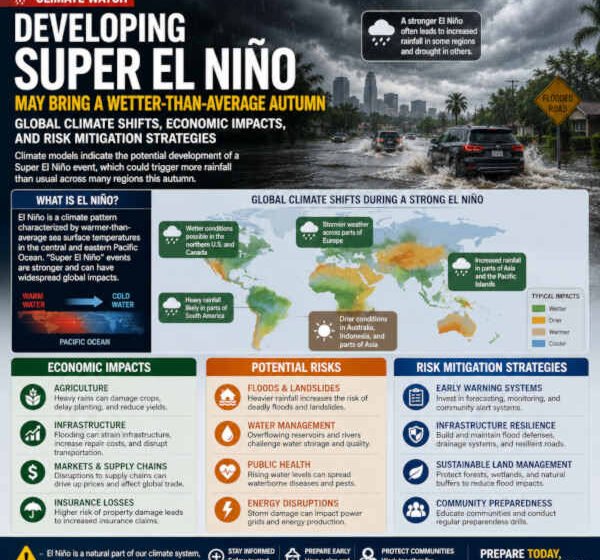
Developing Super El Niño May Bring a Wetter-Than-Average Autumn: Global Climate Shifts, Economic Impacts, and Risk Mitigation Strategies

UK: The latest ECMWF (European Centre for Medium-Range Weather Forecasts) seasonal models indicate an increasingly wet transition into autumn across major parts of the Northern Hemisphere, driven by a rapidly intensifying “Super El Niño” in the tropical Pacific. According to updates from the World Meteorological Organisation (WMO), sea-surface temperature anomalies in the central and eastern equatorial Pacific are accelerating at a historic pace, setting the stage for significant global disruptions to atmospheric circulation, seasonal rainfall, and temperature baselines through late 2026 and into early 2027.
Combined with unprecedented global ocean heat content and a developing positive Indian Ocean Dipole (IOD), this extreme warm-phase El Niño–Southern Oscillation (ENSO) event is shifting storm tracks worldwide. For property owners, agricultural enterprises, and commercial insurers, the developing weather patterns signal an urgent need for proactive climate risk management, flood damage mitigation, and emergency response planning.
Ocean Mechanics: The Evolution of a Super El Niño
El Niño is defined by warmer-than-average sea surface temperatures across the central and eastern tropical Pacific Ocean. When ocean surface anomalies exceed +2.0°C above historical baselines for sustained periods, atmospheric scientists classify the event as a “Super El Niño”.
Forecast models from global meteorology centers indicate that this event could peak near or above +3.0°C to +4.0°C, potentially challenging previous record events recorded in 1997–1998 and 2015–2016.
Tropical Pacific Ocean Surface Temperature Anomaly
Standard El Niño Threshold: +0.5°C
Strong El Niño Threshold:   +1.5°C
Super El Niño Threshold:    +2.0°C
Current 2026 Forecast Peak: +3.0°C to +4.0°C
A massive subsurface Kelvin wave—a massive plume of warm water moving eastward beneath the ocean surface—has fueled rapid surface warming. This shift weakens the trade winds and disrupts the tropical Walker Circulation, releasing vast quantities of thermal energy into the upper atmosphere. This interaction Alters the jet streams that dictate Northern Hemisphere autumn and winter weather.
Regional Forecasts: Atlantic Storm Tracks and Precipitation Shifts
The primary atmospheric driver for Europe and North America during a Super El Niño autumn is the southward displacement and intensification of the jet stream.
Europe and the United Kingdom
-
Enhanced Atlantic Jet Stream: The ECMWF forecast shows an energized Atlantic storm track directing a succession of low-pressure systems toward Western and Northern Europe.
-
Transition from Heat to Moisture: Mediterranean waters reached temperatures up to 32°C during summer. As cooler polar air interacts with this lingering marine heat, regional storm activity and intense convective rainfall are projected to increase during September and October.
-
Elevated Surface Runoff Risks: Consecutive atmospheric river events risk saturating river basins, elevating flood hazards across the UK, Ireland, and Northern France.
North America
-
Southern Tier Deluge: An amplified southern jet stream is expected to route moisture-laden storms across California, the Southwest, the Gulf Coast, and the Southeast US, increasing flood risk.
-
Northern Warmth and Mild Drought: Conversely, high-pressure ridging across southern Canada and the northern US is projected to keep temperatures above average while curtailing seasonal precipitation in the Pacific Northwest.
Economic and Commercial Risk Analysis
The economic exposure associated with a Super El Niño event extends across multiple commercial sectors. Unscheduled downtime, physical asset destruction, and supply chain bottlenecks create substantial liabilities for businesses without disaster recovery protocols.
Key Affected Sectors and Financial Liabilities
| Industry Sector | Primary Climate Exposure | Financial & Operational Impact | Risk Mitigation Priority |
| Commercial Real Estate | Flash flooding, wind damage, roof collapse | Structural loss, business interruption insurance claims | Drainage inspection, roof reinforcement, backup power |
| Agriculture & Farming | Excessive harvesting rainfall, soil erosion, rot | Crop yield reduction, commodity price volatility | Crop insurance coverage, soil drainage improvement |
| Logistics & Maritime | Port delays, inland river flooding, gale winds | Transport delays, supply chain disruption | Alternative route planning, inventory buffer |
| Energy & Utilities | Grid overload, grid infrastructure wind damage | Power outages, infrastructure repair costs | Vegetation management, emergency backup grids |
Insurance, Property Restoration, and Flood Protection
As autumn precipitation increases, commercial property managers and homeowners face heightened risks of flood and water damage. In the wake of major atmospheric river events, insurance claims volume typically spikes, placing extreme demand on property damage restoration services, disaster cleanup companies, and catastrophe insurance adjusters.
Critical Property Protection Strategies
-
Commercial Flood Insurance Audit: Standard commercial property insurance policies often exclude rising groundwater or surface flood damage. Securing specialized flood insurance policies and excess flood insurance coverage is essential for assets located in designated flood zones.
-
Structural Waterproofing & Drainage Maintenance: Property managers should verify that storm drains, sump pumps, backwater valves, and commercial gutter systems are fully operational before the onset of autumn storms.
-
Disaster Recovery and Restoration Contracts: Establishing pre-disaster contracts with certified water damage restoration services ensures priority dispatch for emergency water extraction, structural drying, and mold remediation following heavy rain events.
-
Business Interruption Coverage Review: Ensure business interruption insurance policies adequately cover potential income losses stemming from prolonged utility failures, access road closures, or physical structure repairs.
Agricultural and Infrastructure Preparedness
Beyond structural real estate, extreme weather patterns impact agricultural yields and public civil infrastructure. Excessively wet harvest seasons complicate field operations, increase crop vulnerability to fungal diseases, and disrupt inland distribution routes.
Managing Agricultural Exposure
Farmers facing an unusually wet autumn should consider multi-peril crop insurance strategies to guard against reduced crop quality or delayed harvests. Utilizing modern precision drainage systems and adjusting harvest timelines can help mitigate field losses caused by saturated soil conditions.
Civil Infrastructure Considerations
Municipal authorities and civil engineering firms must prepare for increased stormwater volume. Aging drainage systems, culverts, and municipal levees face heightened structural stress during prolonged, multi-storm sequences driven by a persistent Pacific jet stream. Early capital investment in stormwater infrastructure maintenance drastically lowers subsequent emergency municipal repair costs.
Long-Term Climate Outlook: Preparing for Winter 2026–2027
While autumn brings the initial atmospheric adjustments, Super El Niño conditions typically reach peak intensity between late autumn and mid-winter. Ocean temperature anomalies exceeding +3.0°C indicate that the winter of 2026–2027 could deliver sustained, large-scale climate impacts globally.
The World Meteorological Organization stresses that early warning climate signals provide an essential operational window for businesses, governments, and emergency managers. By acting on long-range seasonal forecasts—upgrading insurance coverage, implementing flood protection measures, and securing emergency response protocols—organizations can safeguard assets and build resilience against one of the strongest El Niño events on record.