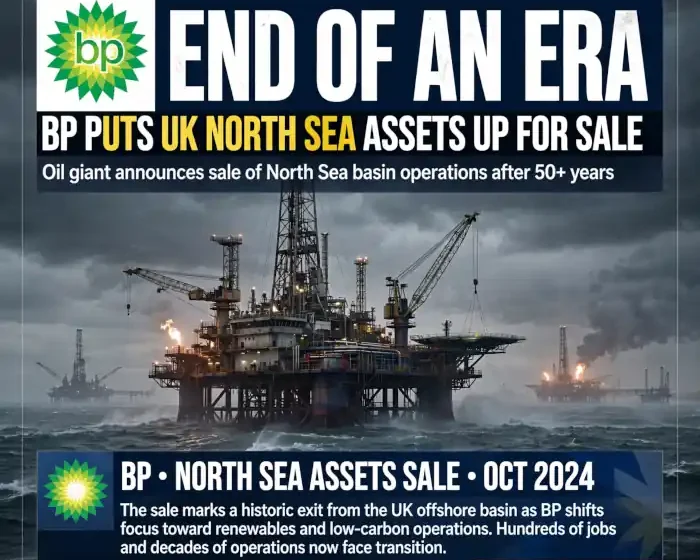
BP, BP North Sea, BP UK North Sea Assets Sale: End of an Era as Oil Giant Puts Basin Up for Sale

LONDON — In a historic shift for the global energy sector, British energy giant BP has officially announced plans to put its entire UK North Sea business up for sale. The landmark decision marks the beginning of the end for BP’s six-decade legacy in the basin—a pioneering presence that helped shape the modern British economy and established the North Sea as a global offshore oil hub.
The announcement forms part of a sweeping corporate review led by Chief Executive Meg O’Neill, who took the helm at BP in April 2026. As the company seeks to streamline its global operations, cut corporate debt, and direct capital toward higher-margin assets, executives concluded that its heritage North Sea portfolio would deliver greater value under new ownership.
While the divestment ends an iconic chapter in British industrial history, it highlights the broader transformation underway across the UK continental shelf as major oil corporations pivot toward higher-yield international basins and new energy vectors.
Why BP is Exiting the UK Continental Shelf
BP’s involvement in the UK North Sea dates back to 1964 when it secured its first offshore licence. Over the following decades, the company made monumental discoveries—including the West Sole gas field in 1965 and the giant Forties field in 1970—which fuelled Britain’s industrial expansion and energy independence for generations.
  [1964: First License] ──► [1970: Forties Field] ──► [2025: 117k boed] ──► [July 2026: Sale]
   BP enters North Sea       Giant discovery triggers  Represents 5% of     Formal sale process
   offshore exploration      UK energy boom            global production    launched by CEO O'Neill
However, mature basins like the UK North Sea face declining natural production rates, higher operational costs per barrel, and evolving fiscal regimes. For BP, the North Sea has increasingly become a smaller piece of its global footprint.
Key DEVELOPEMENT Metrics
- Daily Production: In 2025, BP’s UK North Sea assets produced approximately 117,000 barrels of oil equivalent per day (boed).
- Global Share: This output accounts for roughly 5% of BP’s total worldwide daily production of 2.3 million barrels.
- Workforce: The UK North Sea operation directly employs about 1,100 people.
- Core Operations: The business encompasses five major production hubs—two located in the central North Sea and three west of Shetland. These include a stake in the massive Clair oilfield, the largest remaining oilfield on the UK continental shelf.
In a statement explaining the rationale behind the sale, CEO Meg O’Neill emphasized that capital allocation discipline was driving the decision:
“The North Sea remains integral to the UK’s energy system. However, as we focus our portfolio and direct capital to our highest-value opportunities, we believe our North Sea business will be better positioned as part of another company. It has world-class people, resilient assets and a proud heritage, and it is precisely these qualities that can attract an owner ready to back its next chapter.”
Overview of Major BP Offshore Hubs
BP’s North Sea business comprises vital infrastructure that continues to feed energy into the UK national grid. The assets slated for acquisition represent resilient, producing infrastructure:
| Production Region | Major Hubs / Asset Highlights | Strategic Significance |
| West of Shetland | 3 Major Production Hubs (inc. Clair field) | Houses the largest remaining hydrocarbon reserves on the UK continental shelf. |
| Central North Sea | 2 Major Production Hubs | Mature, highly integrated production infrastructure with tie-back potential. |
| Operational Scale | 117,000 boed across active assets | Provides stable cash flows despite maturing field profiles. |
Politics, Taxes, and the Energy Security Debate
The sale announcement comes at a delicate political moment for the UK government and energy policy. Just days prior to BP’s announcement, UK Prime Minister Andy Burnham voiced support for a “pragmatic approach” regarding North Sea oil and gas extraction. Burnham noted that domestic production remains critical to national energy security during the energy transition, aligning with calls from industry figures and trade unions for sustained investment.
┌─────────────────────────────────────────────────────────────────────────────┐
│                    UK NORTH SEA INDUSTRY TRANSITION                         │
├───────────────────────────────┬──────────────────────────────┬──────────────┤
│ Industry Trend                │ Corporate Action             │ Potential    │
│                               │                              │ Buyers       │
├───────────────────────────────┼──────────────────────────────┼──────────────┤
│ Major Oil Companies Exiting   │ BP joins ExxonMobil, Chevron,│ Focused independent│
│ Mature Basins                 │ Shell, and TotalEnergies in  │ operators & private│
│                               │ scaling back UK footprint │ equity firms│
├───────────────────────────────┼──────────────────────────────┼──────────────┤
│ Focus on High-Yield Global    │ Reallocating capital to      │ Specialized  │
│ Projects                      │ Americas, deepwater, & LNG   │ North Sea    │
│                               │ assets offering higher ROI   │ specialists  │
└───────────────────────────────┴──────────────────────────────┴──────────────┘
Energy analysts point out that BP’s exit reflects broader structural changes across the North Sea. Over the past decade, major international oil companies—including ExxonMobil, Chevron, ConocoPhillips, and TotalEnergies—have systematically sold or scaled back their UK offshore footprints.
Taking their place are focused independent operators and private-equity-backed firms (such as Ithaca Energy or Harbour Energy) that specialize in maximizing efficiency and extending the productive life of late-stage fields.
Protecting Jobs and Energy Infrastructure
Responding to the news, UK energy ministers stated they remain in close contact with BP management. The government’s primary focus throughout the formal sale process will be protecting the 1,100 onshore and offshore workers and ensuring operational continuity without compromising safety or environmental standards.
What Lies Ahead for BP and the North Sea?
BP has reassured investors and staff that it will maintain rigorous safety and operational standards throughout the divestment process. Proceeds from the eventual sale are expected to support BP’s broader financial restructuring, helping lower net debt while freeing up capital for deepwater projects in the U.S. Gulf of Mexico, South America, and global gas developments.
For the North Sea, BP’s formal exit marks a definitive watershed moment. While the basin’s supermajor era is drawing to a close, its infrastructure, skilled workforce, and remaining reserves are poised to pass to a new generation of specialized operators capable of managing late-life production into the next decade.