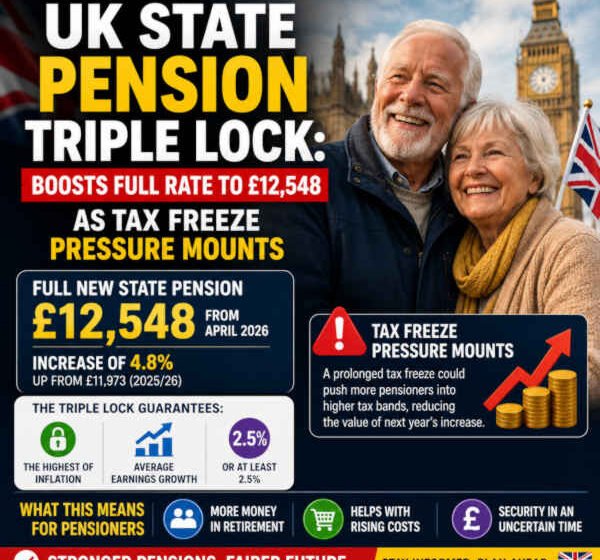
UK State Pension Triple Lock: Boosts Full Rate to £12,548 as Tax Freeze Pressure Mounts

The UK State Pension Triple Lock has delivered a 4.8% increase for the 2026/27 tax year, pushing the full new State Pension up to £241.30 a week—or £12,548 per year. While this £575 annual boost provides welcome relief for over 12 million retirees, it brings the State Pension within just £22 of the frozen £12,570 Personal Tax Allowance.
As fiscal drag threatens to pull millions of pensioners into paying income tax on their state benefits alone, financial planners emphasize that relying solely on the State Pension is no longer a sustainable long-term retirement strategy.
How the Triple Lock Mechanism Works
Introduced in 2010, the Triple Lock guarantees that the State Pension increases every April by whichever of the following three metrics is highest:
-
Average Earnings Growth (May–July of the previous year)
-
Consumer Price Index (CPI) Inflation (September of the previous year)
-
2.5%
For the 2026/27 uprating, average wage growth outpaced CPI inflation (3.8%) and the 2.5% floor, triggering the 4.8% increase across both the new and basic State Pensions.
| Pension Type | Previous Weekly Rate | 2026/27 Weekly Rate | 2026/27 Annual Total |
| New State Pension (Post-April 2016) | £230.25 | £241.30 | £12,548 |
| Basic State Pension (Pre-April 2016) | £176.45 | £184.90 | £9,615 |
Note: Achieving the full new State Pension requires a minimum of 35 qualifying years of National Insurance contributions.
The £12,570 “Stealth Tax” Trap
While the 4.8% uplift boosts retirement income, the government’s freeze on the Personal Allowance at £12,570 until at least 2030 creates a critical tax dilemma:
-
Current Proximity: At £12,548 per year, the full new State Pension consumes 99.8% of an individual’s tax-free allowance.
-
Incomes Above £12,570: Any secondary income—such as a workplace pension, private annuity, SIPP withdrawal, or part-time earnings—is now taxed at the 20% basic rate from the very first pound.
-
The 2027/28 Outlook: Even if the Triple Lock applies the baseline 2.5% increase in April 2027, the State Pension will rise to roughly £12,860, exceeding the personal allowance and making the State Pension taxable on its own for the first time in UK history.
Financial Planning Alert: Retirees with private pension pots face heightened exposure to basic and higher-rate tax brackets as State Pension growth eats up their personal tax-free allowance.
How to Build Secondary Income: SIPP vs. Annuity Strategies
To maintain a comfortable lifestyle in retirement—estimated by the Pensions and Lifetime Savings Association (PLSA) at £31,300 per year for a single retiree—individuals must bridge the gap using private pensions and smart wealth management solutions.
1. Flexible Pension Drawdown via a SIPP
A Self-Invested Personal Pension (SIPP) allows retirees to keep their pension savings invested in the market while drawing down a flexible income stream.
-
Tax Relief Benefit: Basic-rate taxpayers receive an immediate 25% top-up on contributions from HMRC (a £100 SIPP investment costs just £80 out-of-pocket).
-
Tax-Free Cash: At age 55 (rising to 57 in 2028), you can access up to 25% of your SIPP as a tax-free lump sum.
-
Drawdown Strategy: Following the standard 4% sustainable withdrawal rule, generating an extra £10,000 per year requires an estimated SIPP pot of £250,000.
2. Standard Annuities vs. Investment Income
For those prioritizing guaranteed lifetime income over market growth, purchasing an annuity converts a pension pot into fixed monthly payments.
Annuity Strategy:
[ Pension Capital ] ──> [ Fixed Lifetime Payout ] ──> Zero Market Risk

SIPP Drawdown Strategy:
[ Pension Capital ] ──> [ Equity/Bond Portfolio ] ──> Capital Growth + Flexible Withdrawals
Estate Planning Changes Ahead (April 2027)
Retirement planning will face further disruption starting 6 April 2027, when unused Defined Contribution (DC) pensions and SIPP funds will be brought into the scope of Inheritance Tax (IHT) at 40% upon death.
Wealth managers recommend reviewing retirement drawdown sequencing before 2027. In many cases, drawing income from private pensions earlier while utilizing gifting strategies or tax-free ISA allowances can help mitigate future estate tax liabilities.
Summary: Key Takeaways for Pre-Retirees
-
Verify Your NI Record: Check your National Insurance status on the official GOV.UK portal to ensure you qualify for the full £241.30 weekly rate.
-
Account for Tax Drag: Factor income tax into your retirement budget, as State Pension increases will exhaust your personal tax-free threshold.
-
Maximize Tax-Efficient Savings: Take full advantage of SIPP tax relief and ISAs to build supplementary income streams resistant to policy shifts.