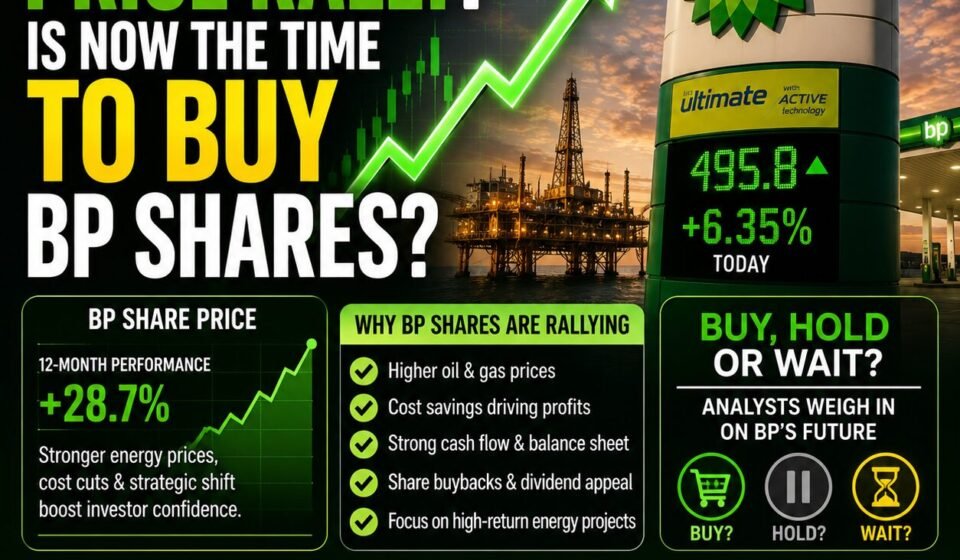
BP Share Price Rally: Is Now the Time to Buy BP Shares?

The BP share price (LSE: BP / NYSE: BP) has experienced a significant rally, gaining approximately 25% since the beginning of the year. Fueled largely by geopolitical tensions, energy market volatility, and a sharp spike in crude oil benchmarks, the British energy titan is delivering its strongest financial performance in years.
With the BP share price trading near multi-year highs and the company undergoing a strategic transition under Chief Executive Meg O’Neill, retail and institutional investors alike are asking: Can this upward momentum last, or is a correction looming?
What Is Driving the BP Share Price Today?
The primary catalyst behind the surge in the BP share price is the dramatic rise in global commodity prices. Geopolitical disruptions in the Middle East—specifically escalating conflict involving Iran—have disrupted global energy export routes, driving Brent crude oil to an average of $103.85 per barrel in the second quarter.
Brent Crude Price Escalation (Q1 vs Q2 Average)
[ Q1 Average ] ── $81.13 / bbl
[ Q2 Average ] ── $103.85 / bbl  (+28% Surge)
In addition to elevated crude realisations, BP’s Refining Indicator Margin (RIM) nearly doubled during the quarter to $29.60 per barrel, generating massive cash inflows across its downstream and trading operations.
Q2 Earnings Breakdown: Profits More Than Double
BP reported stellar financial results for the second quarter, smashing consensus estimates across key metrics:
-
Underlying Replacement Cost Profit: Reached $5.73 billion for Q2—more than doubling the $2.35 billion reported in the prior year period and comfortably beating the $5.01 billion analyst consensus.
-
Attributable Net Income: Net profit skyrocketed 140% year-over-year to $3.91 billion.
-
Debt Reduction: Net debt, hybrid bonds, and lease liabilities decreased by $6.9 billion, significantly strengthening the group’s balance sheet.
-
Dividend Hike: BP confirmed a 4% increase in its quarterly dividend to 8.66 cents per share.
Q2 Underlying RC Profit Growth
[ Q2 Prior Year ] █ $2.35B
[ Q1 Prior Qtr  ] ███ $3.20B
[ Q2 Current    ] █████████ $5.73B (+143% YoY)
Strategic Shift: Restructuring and Asset Disposals
Despite record-breaking profit figures, BP leadership expressed a disciplined perspective. CEO Meg O’Neill publicly acknowledged that operational performance “fell short” of expectations due to upstream plant outages and lower refining throughput.
In response, BP is accelerating a comprehensive corporate restructuring focused on capital discipline, core asset focus, and shareholder returns:
Key Portfolio Moves
-
North Sea Business: BP has put its legacy UK North Sea oil and gas business up for sale after six decades of operations.
-
U.S. Biogas Unit (Archaea Energy): The firm plans to market and sell its Archaea Energy unit as it pivots away from lower-margin green projects to concentrate on high-return hydrocarbon assets.
-
Refining Streamlining: BP completed the divestment of its Gelsenkirchen refinery and reached an agreement to sell its Austrian retail footprint.
By selling off secondary assets and cutting structural costs, BP aims to generate over 20% compound annual growth in free cash flow through 2027 while achieving a return on average capital employed (ROACE) above 16%.
Bull Case vs. Bear Case for the BP Share Price
| Factors Supporting Growth (Bull Case) | Risks and Headwinds (Bear Case) |
| High Oil Price Floor: Brent crude sustained above $100/bbl ensures massive free cash flow generation. | Commodity Volatility: Any sudden de-escalation in Middle East geopolitical tension could pull crude prices back toward $80/bbl. |
| Shareholder Returns: Ongoing share buybacks and a growing 4%+ dividend yield provide downside protection. | Operational Bottlenecks: Lower upstream plant reliability and refining downtime remain an operational risk. |
| Deleveraging Balance Sheet: Lower net debt reduces interest expense and strengthens credit metrics. | Regulatory & Windfall Taxes: Surging profits risk triggering increased political pressure for windfall taxes in Europe. |
Is Now a Good Time to Consider BP Shares?
Evaluating whether the BP share price represents a buying opportunity depends on your long-term investment horizon and appetite for commodity exposure:
-
For Income Investors: BP remains a premier FTSE dividend stock. With earnings comfortably covering the enhanced 8.66c dividend and management committed to aggressive share repurchases, income-focused portfolios continue to benefit from strong cash distributions.
-
For Value Investors: Despite the 25% year-to-date share price surge, BP trades at a notable valuation discount compared to US mega-cap peers like ExxonMobil and Chevron. If management successfully executes its cost-cutting program and asset sale strategy, that valuation gap could narrow.
-
Key Risks to Watch: Investors entering at current levels must be aware that energy stocks are inherently cyclical. Purchasing shares after a massive rally driven by geopolitical instability exposes capital to pullback risk if oil market volatility subsides.
Summary
The short-term outlook for the BP share price remains supported by strong macro tailwinds, $100+ oil prices, and disciplined capital allocation. While operational execution needs improvement, BP’s strategic pivot toward high-margin assets makes it a compelling consideration for long-term investors seeking income and commodity exposure.