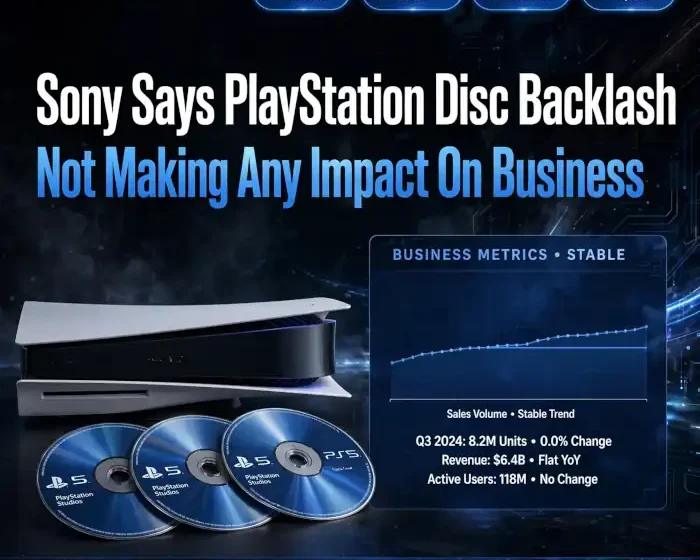

TOKYO / NEW YORK: A breaking UK BUSINESS news update, August 2026, on Sony says PlayStation Disc Backlash. In the news, over the past two decades, passionate fan pushback has repeatedly forced Sony Interactive Entertainment to reconsider, modify, or completely reverse controversial strategic manoeuvres. From the infamous $600 launch price of the PlayStation 3 to the 2011 PlayStation Network outage compensation and the recent mandatory PSN account linking for PC releases, PlayStation enthusiasts have historically used their collective voice to shift executive direction.
However, when it comes to the Sony PlayStation disc future, the gaming giant is sending a crystal-clear message to the market, gamers, and Wall Street: there will be no U-turn.
In its Q1 FY2026 earnings call on Friday, July 31, 2026, Sony formally addressed the escalating global backlash surrounding its plan to phase out physical game discs starting in January 2028. Speaking directly to investors and analysts during a live post-earnings Q&A, Sony Chief Financial Officer Lin Tao confirmed that while the company acknowledges the intense emotional attachment players have toward physical media, the outcry has had zero measurable effect on PlayStation’s financial performance.
Sony CFO Lin Tao Addresses the Backlash Head-On
The executive commentary arrived after weeks of mounting online petitions, fan-organised protests, and heated debates across gaming forums following Sony’s initial announcement that physical Blu-ray discs will no longer be manufactured for new PlayStation titles starting in 2028.
During the earnings call, as reported and transcribed via Kotaku, Sony CFO Lin Tao addressed the sensitive issue directly, explaining the corporate rationale behind the transition while recognising the community’s vocal response.
“And so when we think about the future—and we put in a lot of thought and time, and we cautiously considered this—and we came to this conclusion, and we’re going to cautiously move this forward,” Lin Tao stated through an interpreter. “And to this decision, we have received various opinions, and people have strong views, and we understand that the community has put forth those views to us. Games are loved by many people. It’s a form of entertainment that’s loved by people, and it’s connected to people’s fond memories in many cases. And so we understand those emotions. We want to consider that. And in the future digital ecosystem, how do we engage the gamers is something that we would like to continue to explore.”
When questioned directly by financial analysts regarding whether the vocal opposition had created any headwinds for hardware sales, digital software purchases, or PlayStation Plus subscriptions, Tao was unequivocal regarding the balance sheet.
“At this point in time, we are not seeing any impact on our business,” Tao declared. “But going forward, about the content sales, a large part is already digitized. And therefore, as a result of the discontinuation of discs, we don’t see that there will be any negative impact on our business. However, as I already said, the users, the players have attachments, and we have to think about how to respond to that feedback.”
Industry Analysis: Why Sony Isn’t Budging
Writing for Forbes, Senior Contributor Paul Tassi highlighted the significance of Sony’s firm stance. In Tassi’s analysis, while previous controversies led to corporate course corrections, the pivot away from physical media represents an overarching structural shift that Sony has spent years preparing for—making a reversal practically impossible.
Unlike software feature changes or policy toggles, the infrastructure supporting physical media is actively being dismantled. Sony’s disc-manufacturing plants are already being re-equipped and repurposed for other high-margin optical manufacturing sectors, including optical microlenses and hardware components for high-density computing and artificial intelligence systems.
Furthermore, the consumer trend toward digital downloads has reached a tipping point that makes physical distribution increasingly difficult to justify financially. Internal Sony financial reports indicate that between 82% and 85% of all full-game purchases on PlayStation 4 and PlayStation 5 are now made digitally.
From an economic perspective, digital software offers significantly higher profit margins by eliminating physical production costs, shipping logistics, disc pressing, inventory management, and third-party retail markups.
┌───────────────────────────────────────────────────────────┐
│        PLAYSTATION GAME SALES DISTRIBUTION (2026)         │
├───────────────────────────────────────────────────────────┤
│ Digital Software Downloads  :  ██████████████████  82-85%  │
│ Physical Discs            :  ████                15-18%  │
└───────────────────────────────────────────────────────────┘
What the 2028 All-Digital Timeline Means for Gamers
The timeline laid out by Sony establishes that games released prior to January 2028 will remain available in existing physical stock, but all new first-party releases going forward will bypass Blu-ray discs entirely.
Key Shifts :
- The Code-in-a-Box Retail Model: Traditional brick-and-mortar game stores will not disappear entirely, but the physical products on shelves will transition to boxed packaging containing digital download redemption vouchers rather than physical optical discs.
- Impact on the Secondhand Market: Eliminating physical discs effectively marks the end of the multi-billion-dollar trade-in and used game resale ecosystem. Players will no longer have the ability to lend, borrow, trade, or resell their game libraries.
- Digital Ownership & Digital Preservation: The move accentuates long-standing concerns regarding digital licensing rights. When players purchase digital titles, they acquire a revocable license rather than tangible physical property, raising questions regarding long-term game preservation and account access.
- Hardware Evolution: Premium hardware offerings, such as the PlayStation 5 Pro, have already signaled this direction by shipping as digital-first units without built-in optical drives, positioning disc drives as optional add-ons or legacy accessories.
Differentiating PlayStation in a Digital-Only Era
During the earnings Q&A, investors raised questions regarding whether abandoning physical discs might blur the line between PlayStation consoles and PC gaming platforms, potentially weakening PlayStation’s unique brand identity.
CFO Lin Tao rejected the notion that physical media was the core differentiator for the PlayStation platform:
“We don’t feel that the disc is the factor to differentiate PlayStation from the PC,” Tao emphasized. “The curated content is one of our strengths, and the game environment being stable, that’s another strength. Compared to the high-end gaming PC, our product is more affordable.”
Sony’s position rests on the premise that value lies within its exclusive first-party franchises, seamless user interface, unified trophy system, and plug-and-play console stability compared to the maintenance complexities and higher hardware costs of gaming PCs.
LASTLY IN THE CONCLUSION WE HAVE:
As Sony prepares to move forward with its Sony PlayStation disc future, the company faces a dual mandate: optimising its high-margin digital storefront while managing player trust.
While the vocal opposition from collectors, game preservationists, and physical media advocates remains passionate, the financial metrics demonstrate that the vast majority of consumers have already embraced digital storefronts. With no negative impact on revenue or hardware momentum, Sony remains committed to its 2028 deadline—marking the end of an era for console optical discs and opening a new chapter in all-digital interactive entertainment.
Participate in group discussion online to know more about the latest event sand storis of Sony PlayStation disc future UK news update.