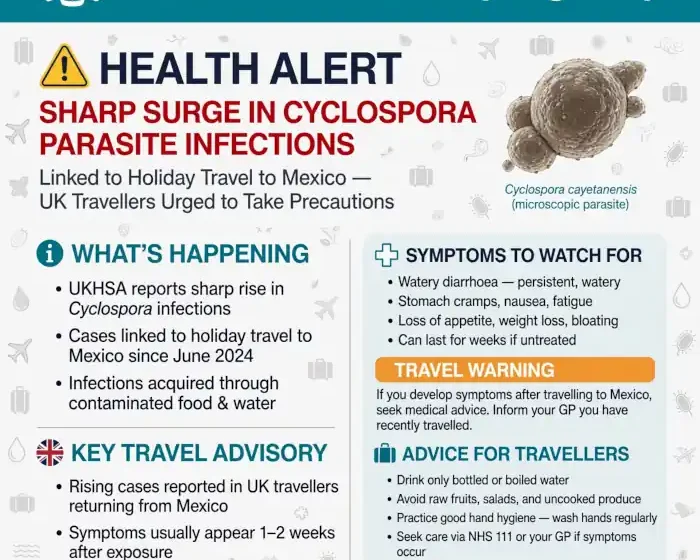
UK Health Security Warning: Sharp Surge in Cyclospora Parasite Infections Linked to Holiday Travel to Mexico

UK,LONDON — Public health officials across the United Kingdom have issued an urgent travel health advisory following a dramatic surge in reported cases of cyclosporiasis—a severe gastrointestinal illness caused by the microscopic parasite Cyclospora cayetanensis.
The UK Health Security Agency (UKHSA), alongside Public Health Scotland and Public Health Wales, published new epidemiological data confirming 67 lab-confirmed cases recorded between April 30 and July 15, 2026. The overwhelming majority of affected individuals were holidaymakers returning from luxury, all-inclusive resorts in popular Mexican tourist destinations.
With peak summer holiday travel underway, health authorities urge travellers to review their travel health insurance, seek professional medical guidance prior to departure, and strictly adhere to rigorous food and water hygiene protocols.
Breakdown of the Outbreak: UK Data Analysis
The recent spike in cases represents a significant deviation from baseline travel-associated infection rates observed in recent years. Between 2022 and 2025, the UK recorded an annual average of 93 cases of cyclosporiasis. The 67 cases identified in just two and a half months signal a sharp seasonal escalation.
                 UK Cyclospora Case Distribution (April 30 – July 15, 2026)
                 ┌────────────────────────────────────────────────────────┐
                 │  England : 30 cases                                    │
                 │  Scotland: 27 cases                                    │
                 │  Wales   : 10 cases                                    │
                 └────────────────────────────────────────────────────────┘
Detailed travel histories obtained for 52 of the 67 confirmed patients revealed a striking common denominator:
- Mexico Connections: 48 patients reported recent travel to Mexico, with one having also visited the United States.
- Resort Clusters: Affected travellers reported staying across various luxury hotels and all-inclusive holiday resorts concentrated in Mexico’s Riviera Maya and Cancún regions.
- Other Destinations: Single cases were linked to travel solely within the United States and Kenya, respectively.
- Demographics: According to UKHSA surveillance, the median age of infected individuals is 46 years old, with females representing roughly 66% of reported cases.
Public health investigators note that infected holidaymakers consumed a wide assortment of fresh food and beverages at their resort buffets before falling ill.
What Is Cyclospora? Transmission & Contaminated Food Risk
Cyclospora cayetanensis is a single-celled protozoan parasite that infects the small intestine. The organism does not naturally occur within the United Kingdom or Northern Europe, meaning virtually all domestic cases are acquired abroad in tropical or subtropical regions where the parasite is endemic.
  [ Contaminated Water / Soil ] ──► [ Unwashed Fresh Herbs, Produce & Berries ]
                                                   │
                                                   ▼
  [ Prolonged GI Illness ]     ◄── [ Ingestion by Unsuspecting Holidaymaker ]
Unlike bacterial pathogens such as E. coli or Salmonella, which can be spread directly between humans or from animals, Cyclospora requires an environmental maturation period outside the host to become infectious. Consequently:
- No Direct Person-to-Person Spread: You cannot contract cyclosporiasis directly from being near or caring for an infected individual.
- Foodborne Contamination: Transmission occurs exclusively through the ingestion of food or water contaminated with human fecal matter containing mature parasite oocysts.
- Resistant Vehicles: High-risk foods typically include fresh, raw produce that is difficult to wash thoroughly—specifically fresh herbs (cilantro, basil), salad leaves, mesclun mixes, snow peas, and soft unpeeled fruits such as raspberries and strawberries.
Food safety experts warn that standard chemical washes or routine kitchen rinsing often fail to remove Cyclospora once the parasite attaches to or embeds within the outer membrane of delicate greens and fruits.
Clinical Symptoms
The incubation period for Cyclospora typically ranges between 2 to 14 days following exposure, with symptoms often presenting around day 7. While mild infections in healthy adults may resolve after several days, untreated cyclosporiasis frequently causes persistent, relapsing gastrointestinal distress lasting several weeks or even months.
“If you develop symptoms after returning from travel, such as watery diarrhoea, loss of appetite, weight loss, stomach cramps, or nausea, please seek immediate medical attention and inform your healthcare professional of your travel history.”
— Dr. Philip Veal, Consultant in Travel Health at the UKHSA
Common Symptom to know
| Clinical Symptom | Frequency / Description |
| Explosive Watery Diarrhoea | Primary symptom; can occur multiple times daily. |
| Severe Abdominal Cramping | Acute lower gastrointestinal pain and bloating. |
| Nausea & Appetite Loss | Pronounced anorexia leading to unexpected weight loss. |
| Systemic Fatigue & Body Aches | Low-grade fever, muscle pain, and chronic lethargy. |
| Flatulence & Belching | Persistent gas and upper abdominal discomfort. |
For patients with underlying health conditions, elderly travelers, or those who are immunocompromised (such as individuals undergoing chemotherapy or taking immunosuppressive prescription drugs), Cyclospora infections can lead to severe dehydration, nutrient malabsorption, and prolonged hospital stays.
Medical Diagnosis, Antibiotics, and Insurance tips
Because symptoms of cyclosporiasis closely mimic other travel-related illnesses like Giardia, Cryptosporidium, or bacterial traveler’s diarrhea, standard clinical observation is insufficient for an accurate diagnosis.
  [ Travel Symptom Onset ] ──► [ Stool Polymerase Chain Reaction (PCR) Test ]
                                                   │
                                                   ▼
  [ Targeted Prescription ] ◄── [ Laboratory Confirmation of C. cayetanensis ]
Specialized Stool Testing
Diagnosing a Cyclospora infection requires specialized microscopic examination or advanced molecular stool PCR testing specifically looking for protozoan parasites. Standard routine bacterial cultures will fail to detect the organism.
Prescription Antibiotic Treatment
Unlike bacterial food poisoning, which may clear on its own, Cyclospora rarely resolves quickly without targeted anti-parasitic treatment. The standard first-line medical treatment involves a specific prescription course of trimethoprim-sulfamethoxazole (co-trimoxazole). Patients allergic to sulfa medications require consultation with an infectious disease specialist or gastroenterologist to arrange alternative therapeutic regimens.
The Role of Comprehensive Travel Insurance
Holidaymakers traveling to Mexico, Central America, or the Caribbean are strongly advised to secure comprehensive travel health insurance with robust medical expense coverage. Emergency medical consultations abroad, private clinic hospitalizations for IV rehydration, and diagnostic lab tests can incur thousands of dollars in out-of-pocket costs if uninsured.
Essential Food & Water Hygiene Guidelines for Overseas Travellers
Health authorities emphasize that staying at five-star or luxury all-inclusive resorts does not eliminate the risk of foodborne parasite contamination. To protect yourself while traveling in regions where Cyclospora is prevalent, follow these prevention rules:
  ┌─────────────────────────────────────────────────────────────────────────┐
  │                      TRAVEL FOOD SAFETY CHECKS                          │
  ├───────────────────────────────────┬─────────────────────────────────────┤
  │  SAFE TO CONSUME                  │  HIGH RISK (AVOID)                  │
  ├───────────────────────────────────┼─────────────────────────────────────┤
  │  • Factory-sealed bottled water   │  • Tap water & ice made from tap    │
  │  • Piping hot, freshly cooked food│  • Raw salads & uncooked herbs      │
  │  • Self-peeled fruits (oranges)   │  • Unpeeled berries & fresh salsa   │
  │  • Hot tea & coffee               │  • Open buffet items at room temp   │
  └───────────────────────────────────┴─────────────────────────────────────┘
- Boil It, Cook It, Peel It, or Forget It: Only eat food that has been thoroughly cooked and is served piping hot.
- Avoid Uncooked Salads & Herbs: Steer clear of raw garnish, cilantro, fresh mint, and cold salad buffets, as raw greens are frequent sources of Cyclospora outbreaks.
- Be Cautious with Fresh Fruit: Opt for fruits with thick skins that you can peel yourself (such as bananas, mangoes, and pineapples). Avoid unpeeled berries, raspberries, and pre-sliced fruit platters exposed to ambient room temperatures.
- Drink Safe Water: Use bottled, boiled, or purified water for drinking, brushing teeth, and making ice. Avoid tap water and ice cubes made from untreated water sources.
Global Context: Widespread Outbreaks in North America
The UK alert coincides with ongoing, large-scale outbreaks of Cyclospora across North America. In the United States, the Centers for Disease Control and Prevention (CDC) has tracked thousands of laboratory-confirmed cases linked to contaminated fresh produce distribution chains.
The UKHSA is working closely with foreign public health agencies, international travel associations (such as ABTA), and Mexican health authorities to monitor agricultural supply chains and resort safety practices.
What to Do If You Feel Unwell Upon Returning Home
If you have recently returned from travel abroad—particularly from Mexico, Central America, or the United States—and experience persistent digestive symptoms:
- Contact Your Healthcare Provider: Schedule an appointment with your GP or a local travel health clinic promptly.
- Explicitly Mention Your Travel History: Clearly inform medical staff of the exact dates, regions, and resorts you visited, as well as any fresh produce consumed.
- Stay Hydrated: Drink plenty of oral rehydration fluids to replace lost electrolytes and prevent severe dehydration while awaiting clinical test results.
- Avoid Preparing Food for Others: Practice strict hand hygiene with soap and hot water after using the restroom to maintain general sanitary safety around family members.