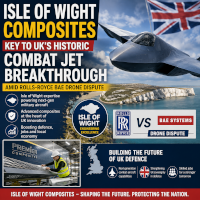
Isle of Wight Composites Key to UK’s Historic Combat Jet Breakthrough Amid Rolls-Royce BAE Drone Dispute

COWES, ISLE OF WIGHT — In a major milestone for British defense manufacturing, GKN Aerospace has completed the engineering, fabrication, and full prototype integration of flight-ready wings, fins, and control surfaces for the UK’s first Collaborative Combat Aircraft (CCA), designated Brontanax. The achievement highlights the advanced composite capabilities housed on the Isle of Wight. However, the program’s rapid industrial progress comes against the backdrop of a high-profile rolls-royce bae drone dispute that has reignited debates over sovereign defense priorities and supply chain independence.
The delivery of structural components from GKN Aerospace’s facility at Cowes represents a critical step forward for BAE Systems’ flagship autonomous fighter project. Unveiled in late July 2026, Brontanax is engineered to serve as a “loyal wingman” to crewed fighter jets such as the Eurofighter Typhoon and F-35. The uncrewed jet is designed to add affordable mass, conduct electronic warfare, gather intelligence, and strike high-value targets while keeping human pilots out of harm’s way.
Isle of Wight Engineering Powers Accelerated Timeline
Progressing from a clean-sheet design within an accelerated schedule, BAE Systems utilised GKN Aerospace’s advanced composite manufacturing and precision assembly networks to satisfy strict technical and aerodynamic criteria.
The flight-ready aerostructures—comprising the primary wing assembly, tail fins, and movable control surfaces—were designed and assembled at GKN Aerospace’s composite center of excellence at Cowes on the Isle of Wight. The successful milestone underscores the island’s enduring role as a powerhouse for aerospace innovation and composite engineering.
┌─────────────────────────────────────────────────────────────┐
│       BRONTANAX CCA PROTOTYPE: INDUSTRIAL CONTRIBUTIONS     │
├──────────────────────────────┬──────────────────────────────┤
│ Primary Aerostructures & Wings│ GKN Aerospace (Isle of Wight) │
├──────────────────────────────┼──────────────────────────────┤
│ System Integration & Testing │ BAE Systems (Warton)         │
├──────────────────────────────┼──────────────────────────────┤
│ Propulsion Unit              │ Williams International (US)  │
├──────────────────────────────┼──────────────────────────────┤
│ Domestic Supply Chain        │ Over 70 UK Companies         │
└──────────────────────────────┴──────────────────────────────┘
Rupert Dix, Senior Vice President of Defence at GKN Aerospace, emphasized the agility required to meet the defense ministry’s aggressive timelines:
“This is the latest example of GKN Aerospace’s ability to turn complex, clean-sheet designs into flight-ready reality at an unprecedented pace,” Dix stated. “By combining our advanced engineering with cutting-edge manufacturing, we are actively shaping the future of next-generation combat air power for the UK and our global allies.”
The rapid component delivery required an agile approach across global supply chains, leveraging novel tooling design, automated composite layups, and complex product assembly. GKN Aerospace’s connected network allowed the firm to balance rapid military prototyping alongside its established commercial production commitments for major civil aircraft lines.
Mark Wilson, Head of Autonomous Collaborative Platforms at BAE Systems, lauded the partnership with the Isle of Wight workforce:
“The rapid progression from concept to prototype integration is a remarkable achievement,” Wilson noted. “GKN Aerospace’s industrial expertise, agility and commitment to collaboration have been pivotal in delivering high-quality, flight-ready structures within an extraordinarily compressed timeline.”
Story behind Rolls-Royce BAE Drone Dispute
Despite the technical triumph at Cowes, the Brontanax initiative remains under intense scrutiny following the contentious rolls-royce bae drone dispute.
When BAE Systems unveiled the Brontanax prototype, the platform was pitched as a benchmark for British sovereign engineering, supported by more than 70 UK-based suppliers and contractors. However, controversy erupted when it was revealed that the drone’s propulsion system would be powered not by domestic industrial titan Rolls-Royce, but by an engine supplied by U.S.-based Williams International.
                     THE ENGINE PROCUREMENT SPLIT
┌─────────────────────────────────────────────────────────────┐
│ BAE SYSTEMS POSITION                                        │
│ • Target cost: ~$25 Million per unit (~25% of a Typhoon)    │
│ • Selected: Williams International (US) engine              │
│ • Rationale: Budget discipline & strict timeline requirements│
├─────────────────────────────────────────────────────────────┤
│ ROLLS-ROYCE POSITION                                        │
│ • Proposed: Orpheus demonstrator concept engine             │
│ • Response: Questions over cost & commitment level          │
│ • Status: Exploring foreign partnerships & future projects   │
└─────────────────────────────────────────────────────────────┘
Reporting surrounding the fallout indicates that the rift between BAE Systems and Rolls-Royce centered on two core friction points: cost management and developmental commitment. BAE leadership sought to keep the production price of Brontanax at approximately $25 million per airframe—delivering roughly 70% to 80% of a manned fighter’s operational capability at a quarter of the financial cost.
Rolls-Royce’s proposed engine option, derived from its Orpheus small-engine demonstrator program, was deemed too expensive for the low-cost, attrition-tolerant profile demanded by the Royal Air Force (RAF). Sources close to the negotiations also expressed frustration, suggesting Rolls-Royce hesitated to fully commit early-stage capital into the demonstrator phase.
Addressing the controversy during a recent media briefing, Rolls-Royce Chief Executive Tufan Erginbilgic pushed back against speculation while keeping communication channels open:
“You should ask BAE that, but it’s a demonstrator,” Erginbilgic remarked when asked about the decision. “I expect these two great companies to work on this. How we ended up here, I don’t want to speculate. But going forward, that opportunity definitely exists.”
For his part, BAE Systems Chief Executive Charles Woodburn reaffirmed the defense prime’s commitment to British industry, highlighting that British suppliers still account for the vast majority of the airframe, avionics, software, and composite structures—including the wings manufactured on the Isle of Wight.
Re-Engineering Air Power a lesson learned
The strategic rationale driving the Brontanax program reflects a fundamental shift in modern air warfare. Recent conflicts across Eastern Europe, the Red Sea, and the Middle East have highlighted the vulnerability of high-cost, low-quantity weapons platforms. Modern integrated air defence systems (IADS) and dense electronic warfare environments make losing multi-million-pound crewed jets unsustainable over prolonged high-intensity campaigns.
                    AIR COMBAT EVOLUTION: CREWED VS. CCA
┌──────────────────────────────────┬──────────────────────────────────┐
│ Crewed Fighter (Typhoon / F-35)  │ Collaborative Combat Aircraft    │
├──────────────────────────────────┼──────────────────────────────────┤
│ High Unit Cost (£80M - £100M+)   │ Low Unit Cost (~$25M / £19M)     │
│ Risk to Human Life               │ Zero Pilot Risk (Autonomous)     │
│ Limited Replacement Speed        │ Rapid Composite Modular Build    │
│ High Maintenance / Flight Hours  │ Scalable Attrition Mass          │
└──────────────────────────────────┴──────────────────────────────────┘
The RAF’s “loyal wingman” initiative aims to re-introduce numerical mass to frontline squadrons. Operating alongside crewed stealth jets, Brontanax platforms can act as forward sensors, electronic attack platforms, air-to-air missile carriers, or defensive decoys.
By offloading risky operational roles to autonomous wingmen, defense planners can preserve both human pilots and valuable crewed aircraft during initial waves of an integrated air defense suppression campaign.
Ground Testing and the Path to First Flight
With GKN Aerospace’s flight-ready wings and control surfaces integrated onto the fuselage at BAE’s primary military aircraft facility in Warton, Lancashire, the Brontanax prototype moves directly into ground-based systems integration and taxi trials.
Supported by a £300 million commitment under the UK Ministry of Defence’s Storm Fighter autonomous initiative, the program aims to conduct initial flight tests in UK airspace in 2027, with targeted operational entry before the end of the decade.
                    BRONTANAX DEVELOPMENT ROADMAP
┌─────────────────────────────────────────────────────────────┐
│ 2026 Q3  : Composite Aerostructures Delivered (GKN Cowes)   │
├─────────────────────────────────────────────────────────────┤
│ 2026 Q4  : Ground Systems & Avionics Integration (Warton)   │
├─────────────────────────────────────────────────────────────┤
│ 2027 H1  : High-Speed Taxi Tests & Initial Flight Trials    │
├─────────────────────────────────────────────────────────────┤
│ 2029-2030: Operational Availability for the Royal Air Force │
└─────────────────────────────────────────────────────────────┘
While the engine selection remains a point of debate, defence analysts view the Isle of Wight milestone as evidence that Britain retains elite capabilities in sovereign aerospace materials, rapid prototyping, and structural assembly.
As ground testing begins, the collaboration between BAE Systems, GKN Aerospace, and dozens of domestic supply chain partners demonstrates that even amid procurement disputes, British manufacturing remains at the forefront of the global race toward autonomous air power.